How to manage staff training, policies and compliance in a cleaning company
A practical guide for UK cleaning companies: which policies and training your team needs, how to get every cleaner to read and sign them, how to keep a training matrix, and what clients and auditors ask to see. Free checklist.
Updated · 9 min read
Download the policy and training checklist (PDF)Every cleaning company has policies. The difference between a small company and one that wins office and agency contracts is usually not what is in them, but whether anyone can prove the team has read them. A folder of PDFs nobody has opened doesn't help when a cleaner is hurt, a key goes missing, or a client's procurement form asks for your training records.
This guide covers which policies and training a UK cleaning company usually needs, how to get them read and signed by a team that is rarely in the office, and how to keep a record that answers the question "who has been trained in what?" in seconds.
Download the checklist as a PDF to tick off what you already have.
Why it matters
- The law. Employers must give their staff the information, instruction and training they need to work safely. HSE explains what that means for a business your size.
- Your insurer. After an accident, the first questions are what training the person had and whether you can show it.
- Your clients. Offices, schools, letting agents and property managers increasingly ask for policies, risk assessments, COSHH records and training evidence before they sign, and again at review.
- Your standards. A policy everyone has actually read is how the same job gets done the same way by ten different people.
The policies and training most cleaning companies need
What you need depends on your work. A two-person domestic cleaning business and a commercial company with forty staff on night shifts are not the same. These are the documents that come up most often:
| Document | Policy or training | Who needs it |
|---|---|---|
| Health and safety policy | Policy | Everyone |
| Using cleaning chemicals safely (COSHH) | Training | Everyone who uses products |
| Manual handling | Training | Everyone |
| Lone working | Policy | Anyone who works alone |
| Key holding and key safes | Policy | Anyone who holds keys or codes |
| Damage and lost property | Policy | Cleaners in homes and holiday lets |
| Data protection (GDPR) | Policy | Everyone who sees client or guest details |
| Working at height | Training | Window cleaners and maintenance |
| Client site inductions | Training | Staff on that client's sites |
Keep each one short. A two-page lone working policy that people read beats a twenty-page handbook nobody opens. Where a topic needs detail, like the safety data sheets for your products, keep that in its own register and point to it. Our turnover cleaning checklist is an example of the kind of practical document a cleaner will actually use.
Getting a mobile team to read and sign
Cleaners start early, work in different places and rarely come to an office. Handing out paper at a team meeting misses half of them, and an email with five attachments gets a thumbs-up and nothing more. What works:
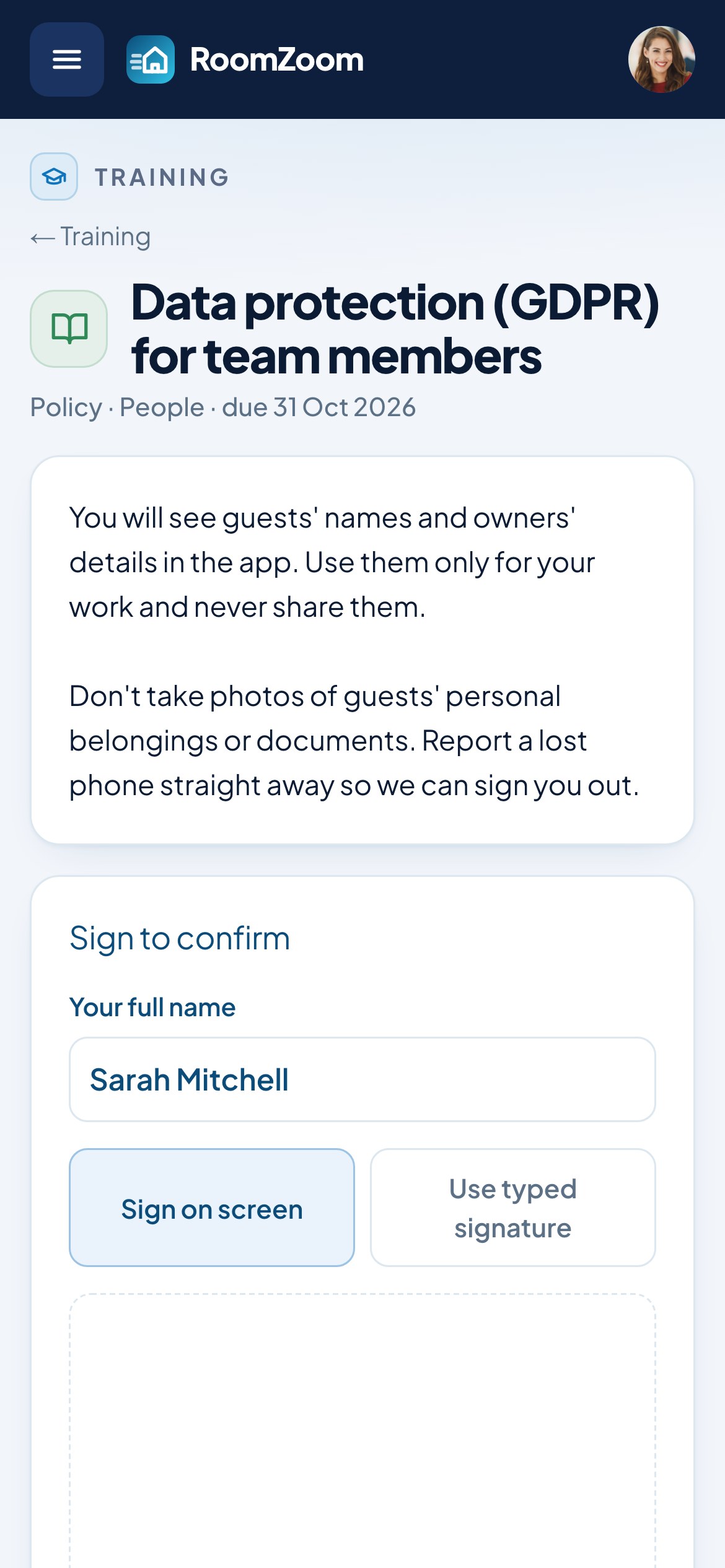
- 1Put each document where they already look: the app or system they use for their jobs, not a separate portal with its own password.
- 2Give each one a due date, so it's clear what is urgent and what can wait until the weekend.
- 3Ask for a signature, not a tick. A name and a date against a specific version is evidence; a read receipt is not.
- 4Remind them automatically, so you aren't the one chasing.
- 5Give new starters everything on their first day, before their first job.
Keep a training matrix
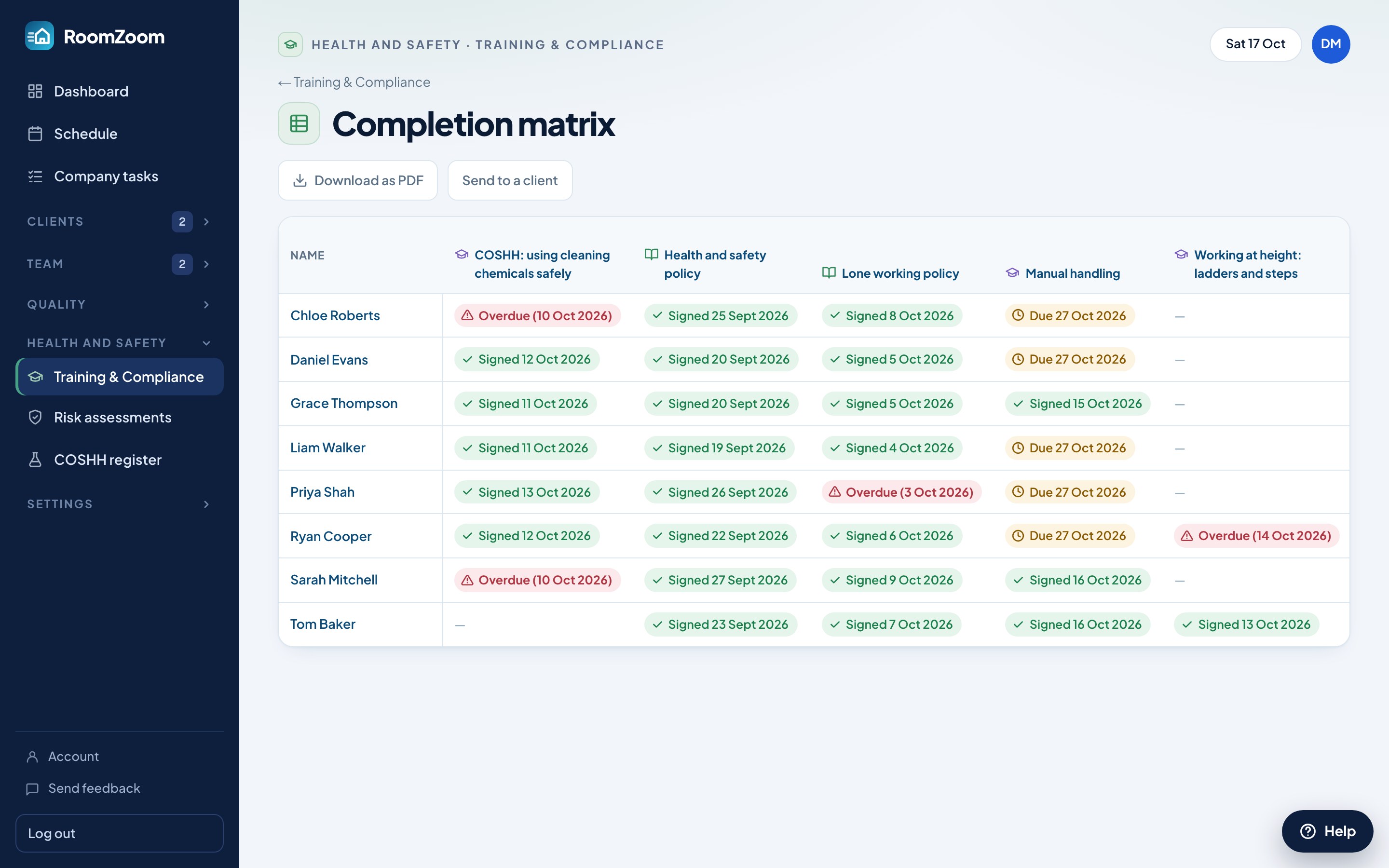
A training matrix is a table with your staff down one side and your policies and training across the top. Each cell says whether that person has completed it, when, and whether anything is due or overdue. It is the single page a client, an insurer or an auditor wants to see, and the quickest way for you to spot a gap.
The spreadsheet version
Most companies start with a spreadsheet: names in column A, documents along row 1, dates in the cells, and red for anything overdue. It works if one person keeps it up to date religiously. It goes wrong when a new starter isn't added, a policy changes and nobody re-signs it, or the signed paper is in a drawer in a different office.
A matrix that keeps itself
If people sign in an app, the matrix can be built from the signatures. Nobody types in a date, a new starter appears with everything they still need to sign, and when you change a policy the whole column goes back to "due" until everyone has signed the new version.
What a good training record shows
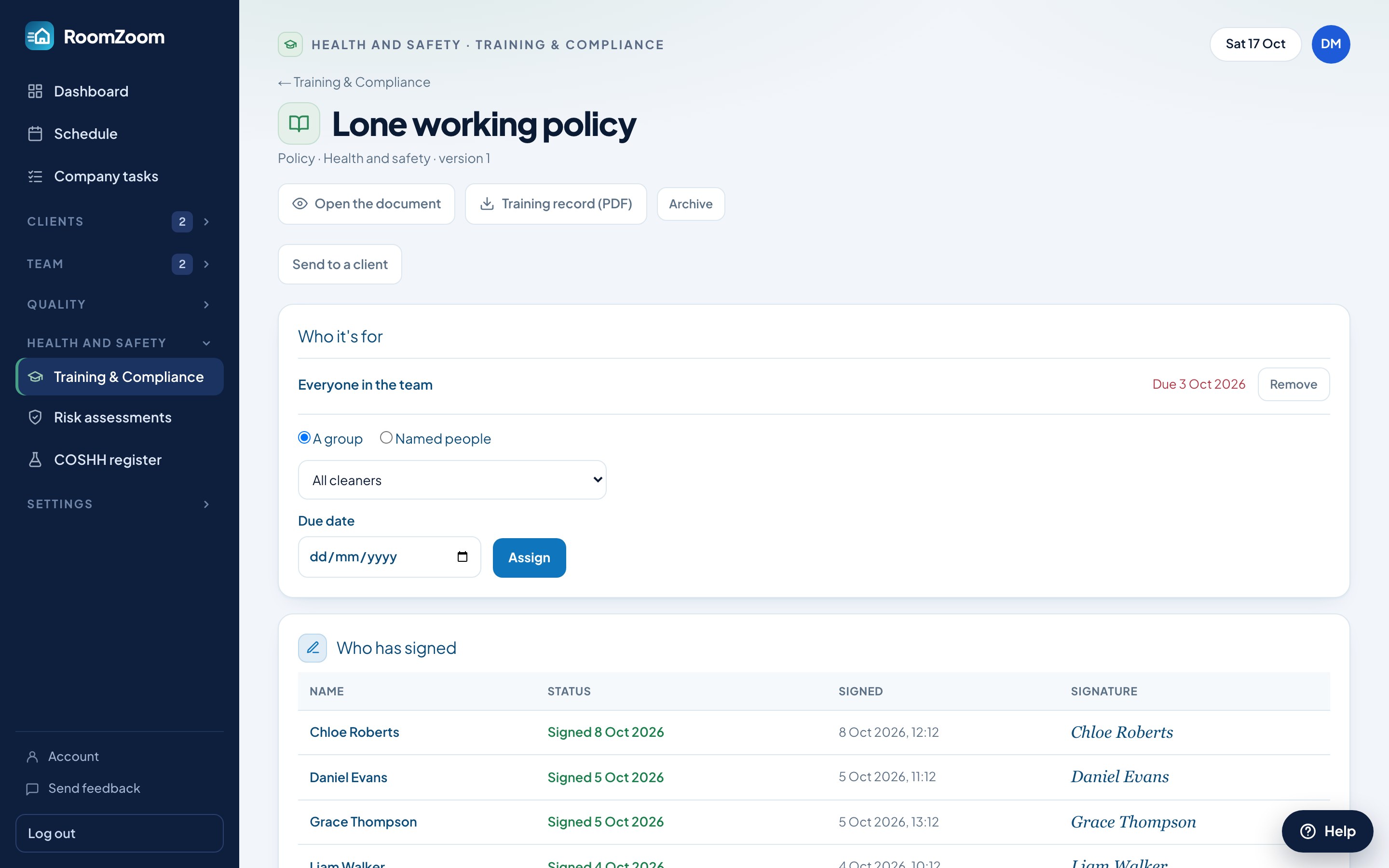
- Which document, and which version of it.
- Who it applied to, and the date it was due.
- Each person's signature, with the date and time they signed.
- Who hasn't signed yet.
- For a policy that has changed, who signed the old version and who has signed the new one.
Keep records for people who have left, too. If a claim comes in about something that happened last year, you need to show the training that person had at the time.
Review and update
Review every policy at least once a year, and straight away after an accident, a near miss, a new type of work or a change in the law. When the content changes, everyone has to read and sign it again. Changing a title or fixing a typo doesn't need that.
When a client asks for evidence
Commercial clients often ask for your health and safety policy, risk assessments, COSHH records and proof of training at tender and again each year. Keep them where you can send them in minutes: the policies themselves, the training matrix, and the record for each document. If you are bidding for office or agency work, our guide to commercial cleaning contracts covers what else they will ask.
The checklist
Health and safety
- Health and safety policy
- Risk assessments for the work you do (RAMS for larger jobs)
- COSHH assessments and safety data sheets for every product
- Using cleaning chemicals safely (training)
- Manual handling (training)
- Lone working policy
- Accident and near-miss reporting
- Working at height, if anyone uses ladders or steps
Properties, keys and clients
- Key holding and key safe procedure
- Alarm codes and access
- Damage, breakages and lost property
- What to do if a property is unsafe or not ready
- Each client's site rules and induction
People
- Code of conduct
- Data protection (GDPR) for team members
- Phones and photos at clients' properties
- Safeguarding, if you work where children or vulnerable adults live
- Equal opportunities, bullying and harassment
- Absence, holiday and time off
Keeping the record
- Who each document applies to, and by when
- A signature and date for every person, for every version
- A training matrix you can print or send
- A date to review each policy
- New starters given everything on day one
How RoomZoom helps
RoomZoom's Training & Compliance keeps your own policies and training in folders, written in the app or uploaded as PDFs. You assign each one to everyone, a group or named people with a due date, and your team signs on their phone in the same app they use for their jobs. The completion matrix and each document's record build themselves from the signatures, and you can download them as PDFs or send them to a client. It sits alongside the COSHH register and risk assessments in the Health and safety menu.
Training & Compliance is part of Pro. Every new company gets 14 days of Pro free, with no card. Start your free trial.
More guides
Run your turnovers from one place.
Scheduling, a cleaner app and AI quality checks for short-let cleaning companies. Free for up to 5 properties.
No card needed · Set up in minutes