How to set up a window cleaning van and pure water system
How KBG builds its water-fed pole vans and makes its own pure water: the filters, tanks, reels, pumps and poles, what it costs per litre, and what they'd do differently.
Updated · 11 min read
KBG Solutions in Lincolnshire runs three window cleaning vans, each with two people on water-fed poles all day. Every litre they use is made in their own yard: hard mains water goes in at about 400 parts per million, and comes out at zero.
This guide is how they do it. It's for anyone starting a window cleaning business, and for cleaning companies adding windows to what they already do. Two parts: making the water, then the van that carries it.
Why pure water
Water-fed pole cleaning works because pure water has nothing in it to leave behind. Scrub the glass and frames with the brush, rinse with pure water, and it dries without spots or streaks. No ladders, no squeegee, no detergent.
Purity is measured as total dissolved solids (TDS), in parts per million (ppm). Mains water in a hard water area like Lincolnshire is around 400 ppm. For spot-free windows you want 0, or very close to it. Much above that and you'll see marks when the glass dries.
You can buy pure water, or make it. With three vans using up to 750 litres each a day, KBG makes it.
Part 1: Making the water
The system, stage by stage
KBG's yard system has five stages:
- 1Two sediment filters take out grit and rust before it reaches anything expensive.
- 2A 40 inch reverse osmosis (RO) unit. The RO membrane does most of the work, taking hard water down to a low reading.
- 3Two resin tanks. Deionising (DI) resin takes out what the membrane leaves, bringing the reading to 0 ppm.
Resin on its own would do the job, but on hard water it would run out in days. The membrane takes the bulk out first, so the resin only deals with what's left and lasts for months.
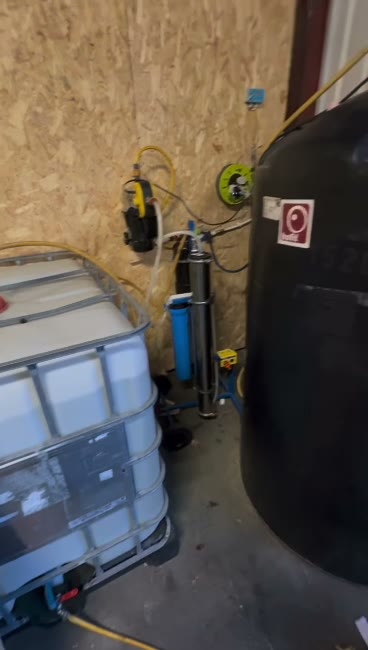
Watch the readings all the time
KBG has a dual inline TDS meter on the wall, an HM Digital DM-1: one probe on the mains water going in, one on the pure water coming out, and a switch on the display to read either. Anyone in the yard can check both numbers in seconds.
The second reading is your warning light. When it starts to creep up from 0, the resin is nearly spent. Change it before the cleaners start seeing spots.
How much it makes, and keeping up
The system makes about 200 litres an hour. That's slow, because hard water takes longer to purify. Three vans need up to 2,500 litres between them, so KBG doesn't wait for demand: the RO runs all the time and fills a 1,000 litre storage tank.
- A float sensor in the storage tank is wired to a solenoid valve. When the tank is full, the valve closes and filling stops. As soon as the level drops, it opens and the system starts making water again.
- A pump after the solenoid switches on when there's demand, pushing water through faster, and shuts down when there's none.
The system tops itself up through the day and overnight, and nobody has to switch it on.
The waste water
Reverse osmosis wastes water. KBG's unit sends about 3 litres to the drain for every litre of pure water it makes. On hard water that's normal, but it adds up: 750 litres of pure water means more than 2,000 litres of waste.
KBG collects the waste in IBC tanks, with an overflow to the drain, and uses it to jet wash the vans at the end of the week and for general cleaning. Most of it still goes to the drain, so every other use you find for it saves money.
Servicing
| What | How often at KBG |
|---|---|
| Sediment filters and RO membrane | About every 4 months |
| Resin | Every 3 to 4 months, or as soon as the outlet reading rises |
In practice the whole system is refreshed about four times a year. On softer water it lasts longer; on harder water, less.
What a litre costs
KBG works it out at about 0.5p a litre for the mains water and waste water charges, and about 1.5p a litre averaged over the year once filters, membranes and resin are included.
Talk to your water company once you're set up. KBG is on a business meter and agreed a reduction in its waste water charges, because most of the water it takes in leaves the site in the vans rather than going down the drain.
Part 2: The van
Choose the van around the weight
Water weighs 1 kg a litre. A full 750 litre tank is 750 kg before you add the tank, frame, reels, pumps, battery, poles and two people. Weight is the first thing to get right.
- Find the van's gross vehicle weight on the plate inside the driver's door. On an ordinary car licence you can drive up to 3,500 kg.
- Work out the load: water, plus fit-out, plus people and kit. Then weigh the van full at a weighbridge. It's the only way to know, and it's cheap.
- Keep everything else light. KBG's shorter vans carry only the window kit, the tank and reels are fixed in rather than loose, and every pole is carbon fibre.
KBG runs two Ford Transit Customs with 750 litre tanks, and a long-wheelbase Transit with a 1,000 litre tank.
Strip and seal the floor first
A window cleaning van gets wet inside every day. Years of small spills soak into a wooden floor until it rots, and a tank is only as secure as what it's bolted into. When KBG refitted the vans that came with the business, this is how they did it:
- 1Strip it back. Rip out the old floor and the lining. On KBG's vans the wooden floor underneath had rotted through.
- 2Clean it to bare metal. Jet wash out the rot and dirt, let it dry fully, and treat any rust.
- 3Coat it. KBG uses Raptor Liner, a tough spray-on coating sold for pick-up beds. Mask up and coat the floor, the wheel arches and the lower walls: everywhere water can sit. On the long-wheelbase van they did the walls and bulkhead too.
- 4Fit the fixing points. Mark out each mounting point, cut through the coating, drill the floor and fit the plates the tank frame bolts to. Seal around every hole: each one is a way in for water.
- 5Then fit the tank and the wiring.
Fitting a new tank on top of a rotten floor just hides the problem.
The tank
Use a baffled tank. Baffles are walls inside it that stop 750 litres sloshing forward when you brake, which you'd feel through the whole van. KBG uses Xline tanks.
Secure it properly. KBG's tanks sit inside reinforced steel frames bolted through the floor. An MOT won't look at it, but an insecure load is an offence, and in a crash 750 kg of water behind your seat has to stay where it is.
If you're reusing a frame, check it properly. KBG's old frames had rusted badly where water had sat against the steel for years, and were cleaned up and repainted before going back in.
Pumps, reels and hose
Each KBG van has two pumps and two powered reels, one for each person on a pole.
- Powered reels with about 70 metres of 6 mm hose each. Winding 70 metres by hand twenty times a day is hard work, which is why KBG moved from hand reels to powered ones.
- Hand reels with 100 metres of hose, kept as extensions for large commercial sites where 70 metres won't reach.
Power
The pumps and reels run from a leisure battery, charged from the van while it's driven. A leisure battery is built to be run down and recharged every day; an ordinary car battery isn't. Charge it through a split charge relay or a DC-DC charger, so the pumps can never flatten the battery that starts the van.
A final polish on the van
On the way out, KBG's water goes through a small DI resin vessel on the van. Because the yard water is already at 0 ppm it rarely has anything to do, but it's a cheap safety net.
Filling up
Each van is filled from the storage tank by a pump. A 750 litre tank takes about 15 minutes. At the moment the cleaners switch the pump on themselves. KBG is moving to an RFID system: a van taps a reader and the supply switches on by itself, so the yard knows which van took how much.
Poles
KBG uses only full carbon fibre poles. Carbon is expensive, but it's light and stiff, and two people using a pole all day feel the difference by lunchtime. It takes weight off the van, too.
Start with two poles that reach most houses: KBG started with two 25 ft Raptor poles, at about £500 each. As the work grows, add lengths for the jobs you take on. Each KBG van now carries a selection from 18 ft for low windows up to 70 ft for tall commercial buildings.
What it costs to fit a van
You don't have to start with the full setup. Here are KBG's figures for a van that will do the job, and for the vans they run now. Neither includes the van itself.
A van to start with: about £1,850
| Item | Cost |
|---|---|
| Baffled tank | about £400 |
| Two pumps | about £200 |
| Two hand-wound reels | about £200 |
| Pipes and connectors | about £50 |
| Two 25 ft carbon fibre poles | about £1,000 |
| Total | about £1,850 |
Add the leisure battery, wiring and floor coating on top.
KBG's vans today: about £5,000 each
Each van now has an Xline tank, two powered reels (with the hand reels kept as extensions), two pumps, a resin vessel to polish the water on the way out, and a selection of carbon poles from 18 ft to 70 ft. Fitted out like that, KBG puts each van's system at about £5,000.
The upgrades are worth spreading out. Powered reels save the most effort day to day; longer poles open up commercial work you couldn't reach before. As Luke at KBG puts it, the van is “just a delivery system”: the real investment is the system in the yard.
Winter
Frozen water is the main risk, and it's in the reels and poles rather than the tank.
- In the yard: keep the storage tank indoors and insulate the pipes. KBG has had no freezing there.
- The vans: bring them into a garage overnight where you can, and cover the reels with thermal sheets on the coldest nights. Powered reels are fixed in, so the van has to come in with them.
- Hand reels and poles: bring them inside every night.
The rules
- Your water company. Tell them before you connect an RO system to the mains. The water fittings regulations require protection against water flowing back into the mains, and they'll tell you what your setup needs. Ask about your waste water charges at the same time.
- Your insurer. Tell them about the conversion and the tank. A converted van that wasn't declared may not be covered.
- Weight and load. Stay under the van's plated weight with a full tank and the crew on board, and secure the tank so it can't move.
What KBG would do differently
- 1Carbon poles from day one. They used heavier poles for a long time, and the people holding them all day felt it.
- 2A much bigger storage tank. The 1,000 litre tank keeps up, but only just. They'd fit at least 5,000 litres: enough to fill every van in the morning and to sell pure water to other window cleaners.
- 3Lay the yard out for servicing. Their RO unit and resin tanks are tucked behind the IBCs, which makes changing filters awkward. Leave room to get at everything you'll service four times a year.
How RoomZoom helps
The van is half of a window cleaning business. The other half is knowing which round is due, who's doing it, and getting paid.
In RoomZoom, regular rounds go on the schedule once, repeating every 1 to 52 weeks, alongside one-off and commercial jobs. Each person gets their day on their phone in the cleaner app, in a suggested order with one tap to open it in Google Maps, and clocks in and out at each job, which builds their timesheets. At the end of the month, invoice from the work that was done.
For commercial clients, RoomZoom's risk assessments and method statements include window cleaning and water-fed poles, and the training matrix shows who has signed your working at height and lone working policies.
KBG runs its window cleaning, cleaning and maintenance teams this way. Read KBG's story, or sign up free, with no card needed.
More guides
Every round on one schedule.
Repeating rounds, routes, a cleaner app, RAMS and invoicing for window and cleaning companies. Free for up to 5 properties.
No card needed · Set up in minutes